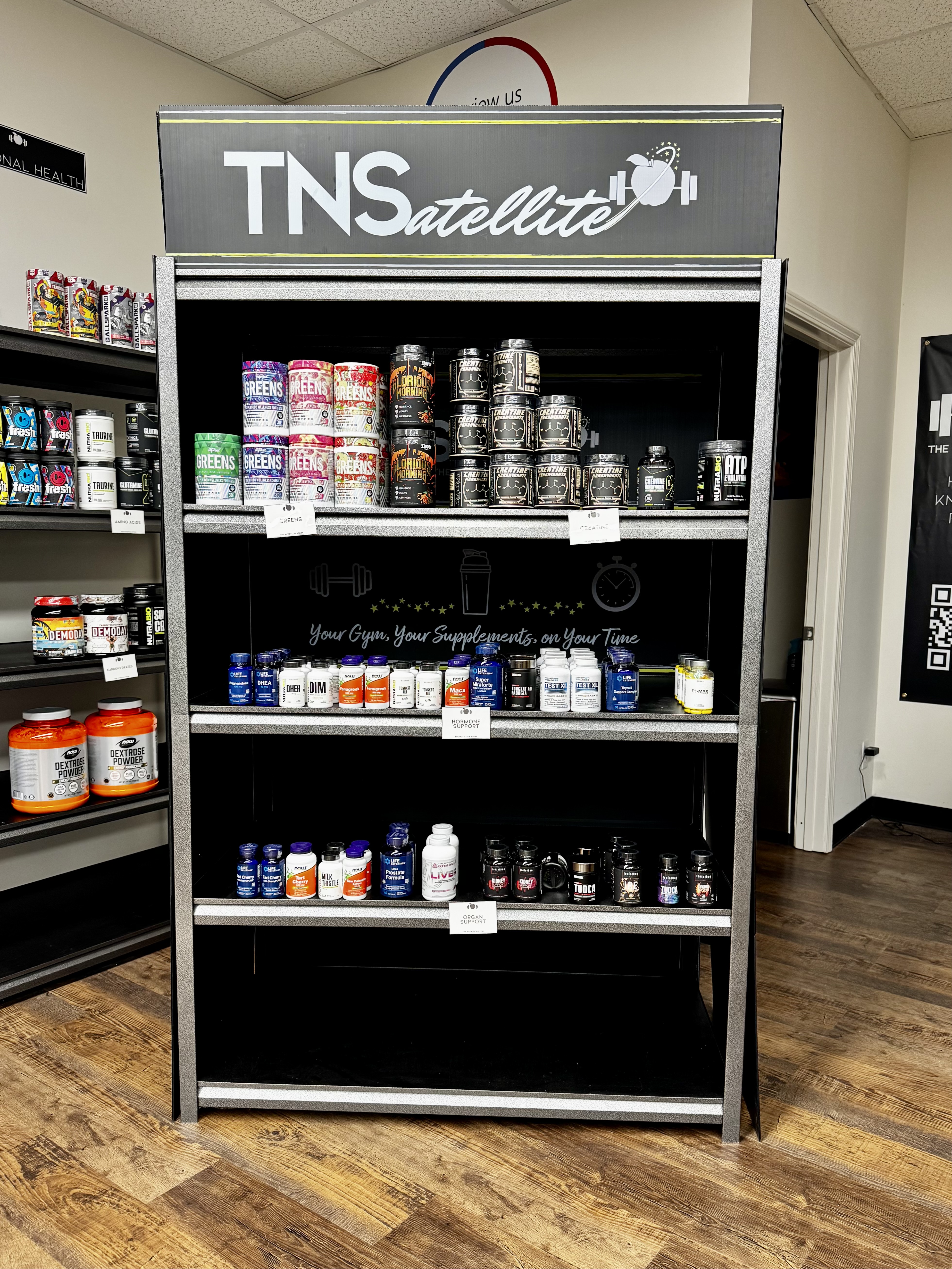
One store. Three satellite locations. Zero extra staff.
How The Nutrition Store expanded a South Carolina supplement brand into three self-checkout gym micro-stores — all running on a single Shopify inventory.
Business
The Nutrition Store
Category
Vitamins & supplements
Location
South Carolina, USA 🇺🇸
Setup
1 main store + 3 satellites
Pendoo plan
Enterprise
3
Unstaffed satellite locations in local gyms
+10%
Monthly revenue increase from satellites
80%
Customer retention rate in 2025
10/10
Likelihood to recommend Pendoo
"
Why would I spend the money on a self-checkout kiosk when every single person already shopping with me has a cell phone in their hand?
Jakob — Owner, The Nutrition Store
The client
The Nutrition Store
The Nutrition Store is an independent vitamin and supplement retailer based in upstate South Carolina. Built around a strong community ethos, the brand has deep roots in its local fitness scene — with relationships spanning multiple gyms within a 30-mile radius of its main store. That community presence wasn't just good for marketing. It became the foundation for a completely new retail model.
TNS
The Nutrition Store
Independent supplement retailer. One main brick-and-mortar store plus three self-checkout satellite locations inside partner gyms across upstate South Carolina.
All four locations share a single Shopify inventory. Every satellite purchase updates stock in real time.
The challenge
Profit margins don't support staffing a micro-store for ten hours a day
The Nutrition Store had built genuine relationships with gyms across its region. The demand was there — gym members already knew the brand, trusted the products, and would buy on the spot if they could. The barrier wasn't interest. It was logistics.
Traditional retail expansion would have meant hiring staff for each location, managing separate inventory systems, and reconciling sales data across multiple channels. For a small independent retailer, the economics simply didn't work.
The alternative — building a custom multi-location checkout system — was quoted at $13,000+ by local tech firms. Physical self-checkout kiosks weren't much better. The owner spent hours searching for a way to keep Shopify as the single inventory source while enabling unmanned checkout across multiple sites.
The solution had to be zero hardware, zero extra headcount, and fully integrated with an existing Shopify setup.
I knew that profit margins for retail don't support me staffing micro-stores for ten hours a day. So how do we let people just check out themselves?
Jakob — Owner, The Nutrition Store
Why Pendoo
Found in a forum comment. Turned out to be exactly the thing.
After hours of searching — and conversations with development firms quoting five-figure builds — Jakob found a single comment on a Shopify Developer Help Centre forum thread recommending Pendoo. He almost scrolled past it. A few days later, having exhausted every other option, he came back to it.
Within days of getting on a call with the Pendoo team, the first satellite location was live.
QR-based mobile checkout
Customers scan a QR code on the satellite shelf, pick up their product, and pay — all from their phone, no download needed.
Single Shopify inventory
Every purchase across all four locations pulls from the same inventory pool. Weekly restocking runs are based on real data, not guesswork.
Instant location switching
Pop-up or temporary locations can be turned on and off instantly, pulling inventory from any specified source location.
Sales data by location
Monthly CSV exports give a clean breakdown of revenue per satellite — used directly to calculate gym profit-share agreements.
The rollout
A prototype shelf. Some Instagram posts. Then live.
Before committing to the first satellite, Jakob set up a prototype Pendoo shelf inside his main store and tested it himself — scanning products, completing purchases, watching where the payment went. Once satisfied, he went live at the first gym location.
Customer communication was handled through the in-store display (a large, self-explanatory printed board), a wave of Instagram content, and an email to the existing customer base explaining how the satellite stores worked.
The big board makes it super self-explanatory. And we made boatloads of Instagram content, then transcribed that into an email that went out to our collected customer base — here's how it works, here's where to find it.
Jakob — Owner, The Nutrition Store
Prototype shelf tested in-store before any gym deployment
Stripe payment integration beta tested by purchasing his own products
In-store QR display board designed to be self-explanatory with no staff present
Instagram content + customer email campaign for each new satellite launch
Gym managers briefed and engaged as on-the-ground advocates
The results
A new revenue stream that runs itself
Three satellite locations, none of them staffed, all feeding into the same Shopify inventory — and contributing meaningfully to the bottom line from day one. The model that seemed too difficult to build turned out to be entirely achievable with the right tool.
+10%
Monthly revenue increase, storewide
Attributable directly to the three Pendoo satellite locations — new revenue generated with no additional staff, no hardware, and no separate inventory system.
No satellite staffing costs
All three gym locations operate entirely without staff. Customers self-checkout independently around the clock.
Data-driven restocking
Weekly restocking runs use real sales data by location. No guesswork, no waste — just a list of exactly what needs replenishing.
80% customer retention
Eight in ten TNS customers in 2025 were repeat buyers — a retention rate the owner attributes partly to the constant brand presence in partner gyms.
Brand presence beyond the store
Even when customers don't buy, they walk past the satellite display and are reminded of the brand — a low-cost awareness channel with measurable retention impact.
Inventory management is critical for us, especially with so many sales channels — online store, physical location, and multiple micro-locations. Knowing what's coming in and going out is essential. You guys do an incredible job with that. Seriously.
Jakob — Owner, The Nutrition Store
8out of 10Customer adoption ease
10out of 10Likelihood to recommend
Peak performance
Pop-ups, turned on in seconds
Beyond the permanent satellites, TNS has used Pendoo for temporary pop-up locations at events — turning on a location, linking it to the relevant inventory, and being ready to take contactless payments without hauling card readers or setting up Wi-Fi hotspots.
Knowing I can just go in and tick on a location — this is turning on, it's going to pull inventory from here — that's massively beneficial. And in the future, even a day package would be incredible for that.
Jakob — Owner, The Nutrition Store
At one event, the satellite presence added an estimated 10–15 transactions that wouldn't have happened otherwise. For a pop-up with no dedicated checkout infrastructure, that's a meaningful conversion rate — with near-zero setup cost.
In their own words
Think outside the four walls
When asked what he'd say to other retailers considering scan-and-go, Jakob's advice was about reframing the opportunity entirely:
Don't think you have to implement it in a way that takes away the experience you provide to your customers. Think of it as a way to expand your brand voice and your brand presence outside of the four walls of your brick-and-mortar. How can you take what you're currently doing and expand it — in an easy way, a trackable way — that places your brand in the eyesight of other potential buyers?
Jakob — Owner, The Nutrition Store
I love that it's a seamless self-checkout system that integrates directly with my Shopify inventory. I think that's a note — and then some. I've caught you guys at a unique time, getting the ball rolling at a very fast pace. I can't wait to see what's next.